London mint
The London mint is the traditional designation for the royal mint in Great Britain, which for centuries struck coins in London, first within the Tower of London and later on Tower Hill. Its issues influenced the form of English and British money from the Middle Ages to the 20th century.
The striking of coins in London is attested already in the Anglo-Saxon period, and the city gradually became the chief financial and administrative centre of the kingdom. In the Middle Ages coinage was concentrated in the area of the Tower of London, where infrastructure for the production of coins, the working of precious metals and state control of their quality came into being. Hammer-striking at that time brought typical irregularities, from an uneven diameter to an off-centre image, and at the same time opened space for dishonest interventions, especially the clipping of edges of silver and gold coins. Precisely for this reason instruments of control asserted themselves in England as early as the Middle Ages, the best-known being the Trial of the Pyx, a traditional examination which verified whether coins corresponded to the prescribed weight and fineness.
From the 16th century it became clear that, with the growth of trade and the volume of payments, more uniform coins were needed. In London mechanical mintage gradually asserted itself, which made possible a deeper and sharper relief and, above all, a more precise circular shape. Together with this, edge security (reeding or inscriptions) developed, which was meant to make the removal of metal more difficult and to facilitate the detection of tampering. The transition from hammer to machine was not, however, a one-off matter: for a certain time older and newer techniques overlapped, and coins of various mintage quality met in circulation.
History
Among the most dramatic moments of London coinage is the end of the 17th century, when the state addressed the mass wear and forgery of silver hammered coins. At this time Isaac Newton was also active at the mint; he took part in reorganising operations and in tightening the fight against counterfeiters. This experience strengthened the emphasis on precision, control and the "industrial" discipline of production, without which the great monetary circulation of the modern state could not have managed.
By the beginning of the 19th century the Tower was already ceasing to meet capacity needs. The London mint therefore moved between 1810 and 1812 into new, purpose-built buildings on Tower Hill (today's complex known as Royal Mint Court). Here production was further modernised and managed ever larger series corresponding to the needs of the industrial and later global economy. In the 1960s, however, it became apparent that even Tower Hill had its space limits, and the state decided to move the mint to Wales. The new complex at Llantrisant was announced in 1967 and put into operation in 1968; the London workshop gradually completed production, and mintage in London definitively ended in the 1970s. Even so, the name "London mint" is used in numismatics to this day as shorthand for the long period when British coins were born precisely in London.
Strikes, marks and collectors' attribution
The London mint struck practically the whole cross-section of English and British coins: from mediaeval pennies and groats through gold nobles, guineas and later sovereigns to modern circulating coinage. For collectors it is important that London strikes often have no "prominent" mintmark; for a number of periods, London origin is recognised rather by the type, style, year and detail of the dies than by a single letter. By contrast, very useful is the edge: machine-struck coins may bear reeding or an inscription, typically DECUS ET TUTAMEN, which at the same time serves as a protection against clipping.
When attributing, it is worth following three things: (1) technology: hammered coins tend to have an irregular edge and a shifted image, machine mintage has a regular circle and clear rim; (2) titulature and portrait of the sovereign, which help to place the issue more precisely; (3) small details such as separating marks in the legend, changes in the crown or shield and traces of die wear. For more expensive pieces the surface plays a great role: careless cleaning and polishing can reduce the value even of an otherwise attractive coin, since collectors prize natural patina and an "honest" appearance of the metal. The London mint is therefore a popular subject not only for the history of money but also for the study of mintage technique, since on its coins the transition from the Middle Ages to modern production is very clearly visible.
In our auction and shop
- Code: RX-Z-033
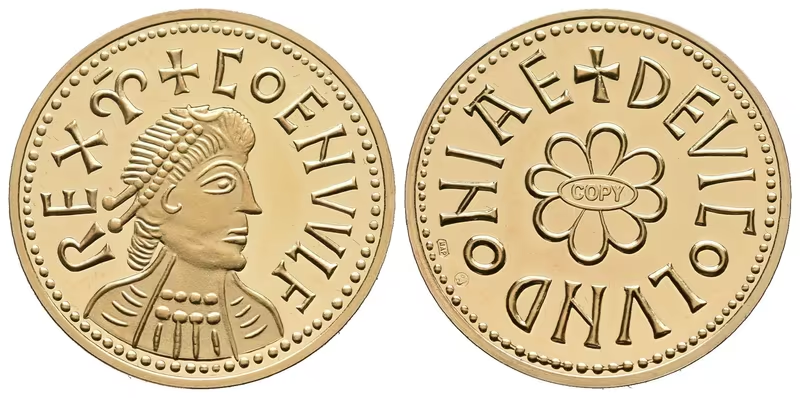
Velká Británie, medaile 796-821 - Coenwulf, král Mercie - flower penny (daisy type), londýnská mincovna, replika
Království Mercie - Coenwulf (796-821) / moderní vydavatel neznámý Medaile 796-821 - Coenwulf, král Mercie - flower penny (daisy type), londýnská mincovna Ag (.925), 25 mm (10 g), v kapsli. Stav mince odpovídá fotografii. Jedná se o druhotný prodej.…
Skladem 1 ks