Graz Mint
The Graz Mint was a historical mint in Graz, which for centuries struck coins for the Styrian and Habsburg lands. Its greatest importance came in the late Middle Ages and the early modern period, when it supplied circulation with small kreuzer pieces as well as higher silver denominations.
Graz, today the capital of Styria, belonged - thanks to its location on the Mur river and on the routes through the Alps - to the natural economic centres of the southern area of the Habsburg lands. For coinage the combination of two factors was crucial: regional sources of metals (in the wider Alpine hinterland) and the need for reliable cash for trade, the collection of dues and the financing of administration. The Graz Mint therefore did not arise as a one-off undertaking, but as part of a long-term effort to keep good circulating currency, conforming to the prescribed weight and fineness, on the market.
Issues associated with Graz are already encountered in numismatic collections and catalogue records in the High and Late Middle Ages. At that time these were chiefly small silver and billon denominations (pfennig types, later half-groschen and groschen), which enabled everyday payments in markets and the town economy. In this period, moreover, the system of leasing out the mint was commonly applied: a minting enterprise could be entrusted to an experienced businessman, who at his own risk procured the metal, the operation and the yield, while the sovereign retained oversight of the legal framework and control. An eloquent example is Balthasar Eggenberger, who established himself in the 15th century as a financier and is also recorded as a mintmaster associated with the Graz coinage.
In the early modern period the mint gained particular importance in the time of the so-called Inner Austria (Styria, Carinthia and Carniola), when Graz became the residential and administrative centre of this part of the Habsburg Monarchy. Under the rule of Charles II of Styria, small denominations were struck in Graz for ordinary circulation, but more representative silver pieces also came into being. It is with Graz that the famous "panther" thaler (Panthertaler) of 1575 is associated, which on its reverse bears the Styrian panther as an expression of provincial identity and the self-confidence of the Estates. Such coins were not merely a means of payment but also a deliberate vehicle of symbolism and prestige.
History
At the turn of the 16th and 17th centuries the mint adapted to the needs of the time, when thaler systems were being established throughout the central European area and pressure was at the same time increasing for small coins for everyday exchange. In the Graz issues, therefore, a broad spectrum of values appears, from small kreuzer pieces up to larger silver denominations. With the person of Ferdinand II of Habsburg, Graz is also linked politically: Ferdinand had long acted here as the Styrian sovereign before his imperial reign, and the coins of his circle show well how titulature and the composition of emblems were adapted to changes of power and contemporary representation.
In the 17th century, war and financial upheavals strongly intervened in coinage, including in the Habsburg lands. In such periods the importance of controlling fineness increases, and at the same time the risk grows that "good" and "poorer" issues from various places would be mixed in circulation. The Graz Mint therefore stands in numismatics also as a practical demonstration of how regional mints sought to maintain confidence in circulating currency, despite the parameters of coins changing over time according to ordinances, the availability of metal and fiscal needs. For collectors, this very temporal stratification is one of the main reasons for the attractiveness of Graz issues.
The production of the Graz Mint comprises chiefly silver and small coins: pfennigs, half-groschen, groschen, kreuzers and, in the early modern period, also thaler denominations. With some Renaissance issues, a richer portrait stylisation and the coat of arms of the Habsburg lands are encountered, whereas the small denominations often work with a simpler expression of value and with heraldry. A special place is held by representative pieces of the panther-thaler type, which stand out for their iconography and tend to be sought after both for the artistic level and for their clear anchoring in Styrian tradition.
Issues, marks and identification of coins
For identifying a Graz issue it is best to combine several signs: the titulature and the likeness of the sovereign, the style of the eagle or shield, the shape of the script and also the mint marks. Mint marks changed over time - sometimes the origin is evident directly from the legend, at other times an abbreviation or letter used in a given period helps. With hammer-struck issues, irregularity of cut and shifts of the impression are common, so when comparing, it also matters whether the whole legend is legible and whether the basic parameters (weight, diameter, type) correspond. With small coins, moreover, pronounced circulation wear is often encountered, while with thalers and "display" pieces the quality of the surfaces, the edges and any later cleaning also play a role.
In practice, Graz coins are collected either as part of Styrian and Habsburg coinage, or thematically according to rulers and types (for example thaler denominations, kreuzer series or estate issues). Graz thus represents an important regional centre on which it is well seen how European monetary standards were reflected in a particular town, its administration and everyday economy.
In our auction and shop
- Code: XB-1000
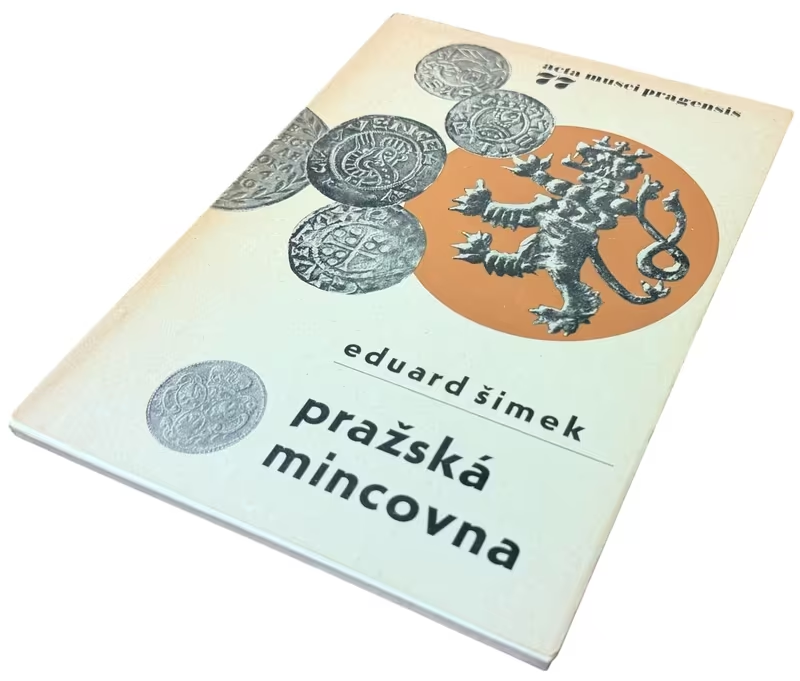
Pražská mincovna
Šimek, Eduard Pražská mincovna devět století české mince - katalog výstavy Praha 1977, 38 stran a 48 stran vyobrazení, brožované, pěkná zachovalost
Skladem 1 ks - Code: MC138-PROOF6
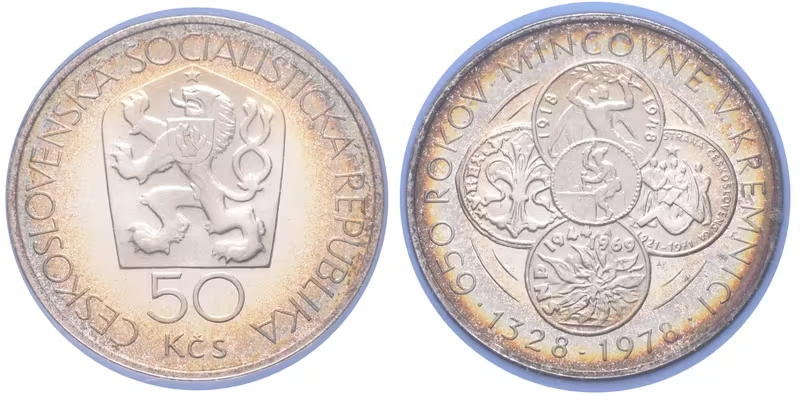
50 Kčs 1978 - Mincovna Kremnica, PROOF
Československo (1953 - 1993) 50 Koruna 1978 - 650. výročí mincovny v Kremnici, autor Andrej Peter, Aurea 138, PROOF Ag 0,700, 31 mm (13 g), raženo 70 076 ks (běžná kvalita), 2 708 ks (proof), původní plastová kapsle, patina v ploše - viz foto
Skladem 1 ks - Code: MC138-PROOF5
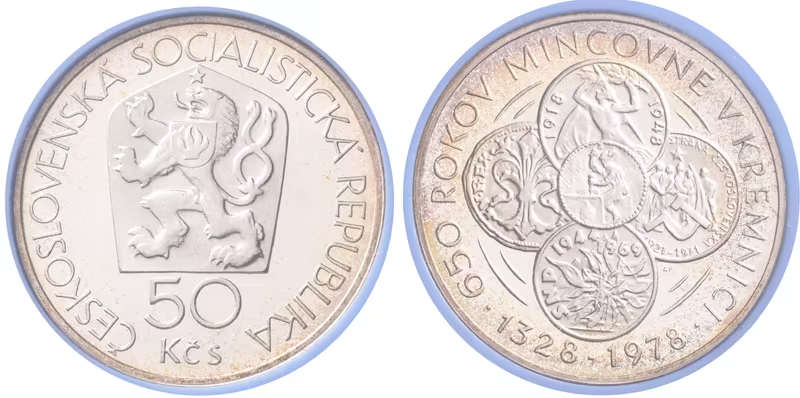
50 Kčs 1978 - Mincovna Kremnica, PROOF
Československo (1953 - 1993) 50 Koruna 1978 - 650. výročí mincovny v Kremnici, autor Andrej Peter, Aurea 138, PROOF Ag 0,700, 31 mm (13 g), raženo 70 076 ks (běžná kvalita), 2 708 ks (proof), původní plastová kapsle, patina v ploše - viz foto
Skladem 1 ks - Code: MC138-PROOF4
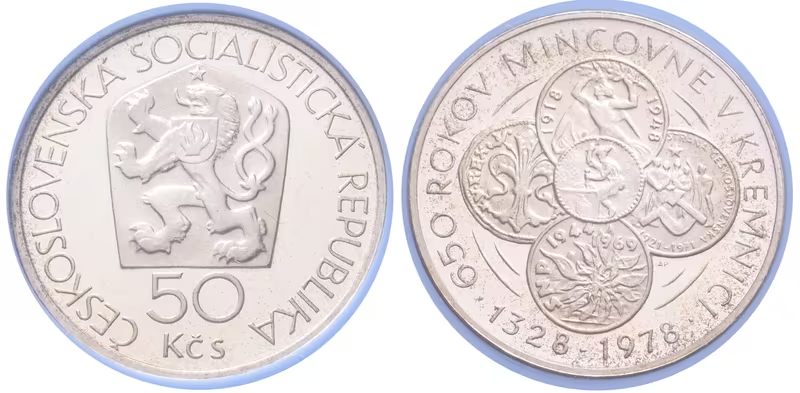
50 Kčs 1978 - Mincovna Kremnica, PROOF
Československo (1953 - 1993) 50 Koruna 1978 - 650. výročí mincovny v Kremnici, autor Andrej Peter, Aurea 138, PROOF Ag 0,700, 31 mm (13 g), raženo 70 076 ks (běžná kvalita), 2 708 ks (proof), původní plastová kapsle, patina v ploše - viz foto
Skladem 1 ks