Pobjoy Mint
The Pobjoy Mint was a British private mint (1965-2023) which struck both circulating and commemorative coins for a number of states and overseas territories from its base in Tadworth, Surrey. It was also famous for technical innovations, for example the first coins made of titanium and unusual materials in modern coinage.
The rise of the Pobjoy Mint is an example of how, in the second half of the 20th century, specialised private enterprises established themselves alongside state mints. While the traditional national mints concentrated chiefly on the circulating tender of their own state, small countries and overseas territories often sought a partner who could provide the design, production and distribution of commemorative issues and sometimes also ordinary coins. It was precisely this space that Pobjoy entered - first as a workshop linked to work with precious metals and bespoke production, later as a fully-fledged mint with an international clientele.
The enterprise was founded in 1965 by Derek Pobjoy. The basic idea was practical: the acquisition of a minting press and the use of experience in metalwork and engraving for the production of medals and coins in limited mintages. From the outset, the mint oriented itself to quality bespoke work - from medals and tokens up to series for the collector market. Commemorative issues in particular were attractive to smaller commissioners, because they allowed them to "tell a story" through metal: anniversaries, state symbols, nature, maritime tradition, important personalities or events that had value for local identity.
In the 1970s Pobjoy more significantly established itself in the programme of coins and stamps for selected territories, especially in the British overseas circle. It was here that the advantage of a private mint showed itself: it could flexibly respond to demand for new themes and at the same time maintain the technical quality of striking, which is essential for collectors. Alongside commemorative coins, Pobjoy also participated in the production of part of the circulating tender for some territories and at the same time struck coins for various sovereign states outside Europe. Through this, the Pobjoy Mint gradually ranked among the producers who "stand in the background" of a large part of modern world commemorative issues.
History
From the point of view of numismatics, a combination of tradition and experiment is typical of Pobjoy. The mint was not afraid to use less common metals and alloys, which were to distinguish the issues and at the same time bring technical interest. Known, for example, is the work with titanium, the use of which in coinage belongs to the more demanding because of its hardness and the specific behaviour of the material during striking. Pobjoy in particular became famous because for Gibraltar at the end of the 1990s it issued one of the first legally valid coins of titanium, by which it drew the attention of both collectors and the professional public. Alongside this, the mint participated in issues of platinum and other precious metals, and in some programmes it also experimented with more pronounced security or optical features.
The operation of the mint long rested on the family character of the firm and on the ability to combine design, production and the commercial side of programmes. It is precisely this which explains why Pobjoy became a partner of many small commissioners: they were often looking not only for a "producer of metal", but also for someone to help with the concept of the series, the artistic solution and the overall realisation. After almost six decades of activity, however, the mint ceased operations in 2023, by which one distinctive chapter of modern private coinage in the United Kingdom was closed.
The Pobjoy Mint produced both circulating and commemorative coins, medals and tokens. With commemorative issues, the breadth of themes and the use of various materials is typical: from ordinary alloys through silver and gold to less common metals which increase the attractiveness of the series. On a number of coins the small mint mark "PM" appears, which helps to distinguish the origin of an issue, especially in the case of issues for British overseas territories. For collectors it is important to distinguish whether the piece has the status of legal tender (with a face value) or is a medal, and further to track the mintage, the finish (ordinary strike versus proof) and the state of the surface.
Production, marks and collecting practice
The value of Pobjoy issues is usually formed by the combination of theme, rarity and state of preservation; with precious metals the intrinsic value of the metal also comes into play. Because Pobjoy struck for many commissioners, correct attribution to a territory, year and specific programme is key when identifying - the same motif may exist in several sizes, metals and finishes. With modern pieces it pays to leave coins in capsules or in the original packaging and to avoid cleaning, which may damage the surface and reduce collector attractiveness.
In our auction and shop
- Code: SMAN90-D1982
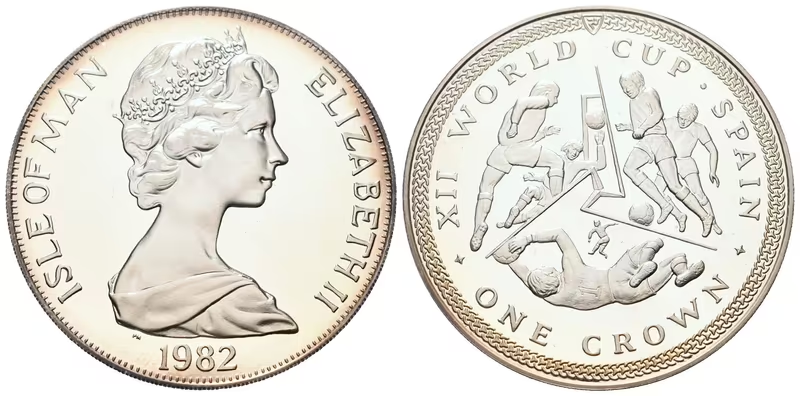
Ostrov Man, 1 Crown 1982 - Mistrovství ve fotbale
Ostrov Man, Elizabeth II. (1952 - 2022) 1 Crown 1982 - Mistrovství světa ve fotbale, KM# 94a Ag (.925), 38,6 mm (28,28 g), proof. V kapsli. Emise: 15 000 ks. Mincovna: Pobjoy Mint - Velká Británie. Stříbrná pamětní neoběžná mince, ze série mincí vydaných…
Skladem 1 ks - Code: SMAN90-D1997
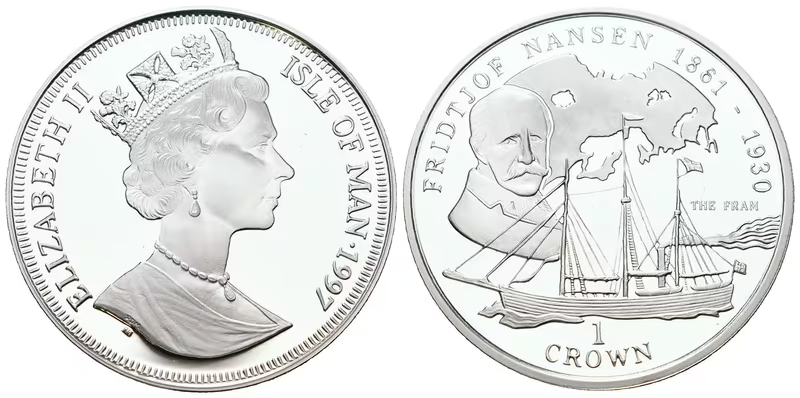
Ostrov Man, 1 Crown 1997 - Fridtjof Nansen
Ostrov Man, Elizabeth II. (1952 - 2022) 1 Crown 1997 - Fridtjof Nansen, KM# 768a Ag (.925), 38,6 mm (28,28 g), proof. V kapsli. Mincovna: Pobjoy Mint - Velká Británie. Stříbrná pamětní neoběžná mince, ze série "Great Explorers of the World" (Velcí…
Skladem 1 ks