Tudors
The Tudors were an English royal house that reigned from 1485 to 1603 and fundamentally shaped the politics and economy of England. For numismatics they are important for currency reforms, transformations of the ruler's portrait on coins and the episode of debasement of silver coinage in the 16th century.
The accession of the Tudors is traditionally linked with the end of the Wars of the Roses. After 1485 Henry VII stabilised royal power and based it also on more careful management of finances. In coinage this meant an emphasis on credibility and representation: the coin was not merely a means of payment but also a "royal document" in metal, which travelled daily through the hands of subjects. In the Tudor period the portrait conception of the ruler is therefore gradually strengthened and the importance of inscriptions and emblems expressing the legitimacy of rule grows.
Under Henry VIII England entered a period of costly politics and military expenditure that was reflected in the currency as well. It is precisely with his reign that the best-known episode of debasement is associated, known as the Great Debasement (a descriptive term "velké zhoršení ryzosti" is used in Czech). In silver coins the share of precious metal was gradually reduced so that the state could obtain a short-term fiscal profit from minting. Such steps could indeed bring money in quickly, but at the same time they undermined trust in the currency, increased price instability and worsened the functioning of the market.
In the following decades the situation developed further under the reigns of Edward VI and Mary I, when a balance was sought between the needs of the treasury and the stability of the currency. For collecting and historical purposes this period is interesting in that on the coins the rulers' portraits, titulature and symbolism alternate, which allows the dynastic and religious transformations of the age to be tracked well. At the same time, with some denominations and issues, there is pressure for rapid production of currency.
History
Under Elizabeth I came an effort to restore confidence in the silver currency. The Elizabethan period is associated with extensive re-coinage and a return to better silver standards, in order to withdraw debased pieces from circulation and to restore stability. Alongside this, technological experiments also appear in the Tudor period: while most strikes were still hammered (struck by hand), in the 16th century the first machine processes were also tried in England, aimed at a more regular shape and a more precise execution of coins. The Tudor era thus stands at the boundary between medieval and early modern coinage — from traditional hand striking to gradual mechanisation.
The Tudor dynasty died out in 1603 with the death of Elizabeth I. Their reign, however, left a marked imprint on the monetary circulation: from ambitious denominations and representative gold strikes through to an instructive period of monetary crisis and subsequent stabilisation that shows how sensitively the currency is linked with state policy.
In Tudor England the traditional pound sterling system was used, in which values were expressed through shillings and pence. Alongside small silver denominations larger coins were also struck, which were to facilitate higher payments and at the same time had a representative effect. The period is characterised by coins bearing a distinctive royal portrait and titulature; with some issues even the style of depiction changes, so that by the relief and the lettering individual reigns and sometimes even specific issue stages can be well distinguished.
Coins of the Tudors and their typical features
For the numismatic identification of Tudor coins it is essential to follow the metal (gold vs. silver), the denomination, the date (if present) and also the mint marks or issue marks, which help to distinguish individual series. With hand striking, irregularity of the flan and fluctuation in the quality of the strike are common, which is typical of this period. By contrast, attempts at machine striking sought to bring a more uniform circular shape and sharper detail, although they did not prevail on a broad scale until later.
With Tudor strikes the period of debasement has special significance: with silver coins the appearance of the surface and the "colour" of the metal can be a clue as to whether they are issues with a higher share of base metal alloys. At the same time, however, expert identification of the specific type and issue phase is decisive. Tudor coins are thus a valuable source not only for the history of England but also for an understanding of how the state uses coinage as an instrument of power, propaganda and finance.
In our auction and shop
- Code: ZD-2021HLU
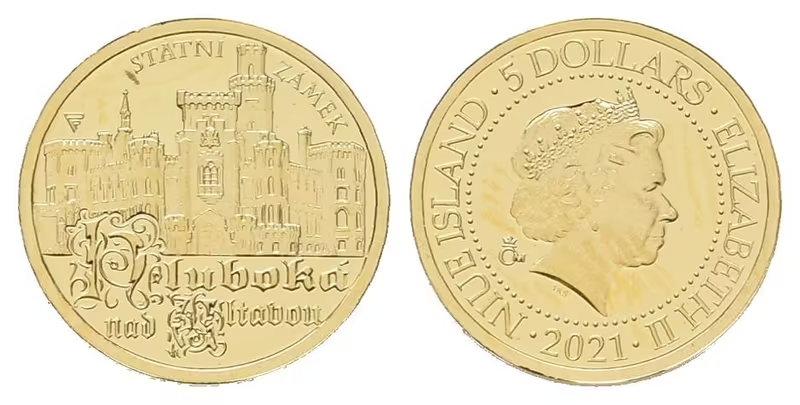
Zlatá mince Zámek Hluboká - dobová pohlednice
Niue 5 Dollars 2021 (Petr Patka) - Zlatá mince Zámek Hluboká nad Vltavou v dobové pohlednici Au 0,9999, 11 mm (0,5 g), náklad 2000 ks, PROOF Další významnou pamětihodností, která se objevuje na zlaté miniminci České mincovny zasazené do repliky…