Mortuary Issues
Mortuary issues are coins and medals issued to commemorate the death of a ruler or another significant personality. They belong among commemorative issues that bear a portrait, inscription or symbols associated with the deceased and often arise shortly after death as a public tribute and contemporary document.
Mortuary issues build on the older tradition of commemorative coins and medals, which already from the Middle Ages served as a means of public representation. While ordinary circulating coins fulfilled chiefly a payment function, commemorative issues also had a political and symbolic significance: they commemorated an extraordinary event, consolidated the legitimacy of the successor and helped to create the "official memory" of the deceased. The death of a ruler was, in pre-modern times, a moment when attention focused on the continuity of power, and it was precisely coins and medals that offered a rapidly distributable and easily understood carrier of a message — a portrait and titulature could say more than long texts.
In the Middle Ages, mortuary motifs appeared rather exceptionally, because coinage was firmly bound to circulation and to monetary stability. Commemorative issues therefore appeared chiefly in the form of medals or special issues that were intended more for giving as gifts, representation and preservation than for mass payment. With the development of the Renaissance medallic tradition, commemorative medals became an important part of court culture: they captured the appearance of personalities, significant events and programmatic inscriptions. Mortuary issues fitted well into this logic — they offered an opportunity to express respect, to emphasise the merits of the deceased and at the same time to present the order of succession or the values that the new regime was to proclaim.
In the Czech context, mortuary issues can be understood as part of a wider commemorative production, which changed according to the period and the commissioner. In the early modern period, alongside medals there could also appear coins with a clear commemorative purpose. An example from the traditional numismatic literature mentions the Jáchymov thaler struck in memory of the death of Stephen Schlick, linked to the year 1526. Similar issues illustrate that the commemorative motif could penetrate even into the coinage environment, especially when the event concerned a significant person linked to power, prestige or the economic hinterland of the mint.
History
In the 19th and 20th centuries, mortuary issues gained a wider space thanks to the development of modern medallic art, state institutions and also thanks to the fact that commemorative coins began to be a more common part of monetary policy. Mortuary issues could appear as official state issues, but also as medals commissioned by associations, towns or cultural institutions. In this period, it was no longer only about dynastic continuity, but also about civic memory: statesmen, scientists, artists or symbolic personalities of modern history are commemorated. To this line also belong the issues related to the death of Tomáš Garrigue Masaryk in 1937, when commemorative coins and medals arose, often with an emphasis on the portrait conception and clear identification of the event by year.
Mortuary issues are sometimes mentioned in connection with the concept of "posthumous issues", which can designate a wider range of issues arising after the death of a person (not always necessarily directly "on the occasion of death"). In practice the boundaries overlap: what is decisive is the intention of the issuer and the textual or pictorial message on the issue. It is precisely for this reason that mortuary issues are valuable for both the historian and the numismatist — they connect art, politics and contemporary memory in an object that can be precisely dated and read as testimony of its time.
Mortuary issues are usually recognisable by their unambiguous link to the deceased person and to the event of death. On the obverse or reverse, a portrait, name and titulature (in the case of rulers), or civil designation and function (in the case of modern personalities), often appears. Typical are also textual formulas of commemoration, the year and symbolism of mourning or memory, for example wreaths, branches, crosses or other period-acceptable signs of a pious character. With medals, a longer inscription and narrative motif are more often used, while coins — if of a circulating character — tend to be more sparing in composition.
How to recognise mortuary issues and what features they bear
The material and purpose can differ considerably. With smaller issues, more common metals predominate, with more representative pieces silver and exceptionally also gold. Medals are usually intended for preservation and giving as gifts, so the quality of the relief and artistic execution is given attention. With coins, the question of whether they were circulating currency or a commemorative issue with a limited mintage is also important. In both cases, however, mortuary issues function as a "material memorial": they transfer the image and name of a personality into the everyday world or into the collecting environment and enable the commemoration of the event to spread throughout society.
In our auction and shop
- Code: RC-PRAH1899
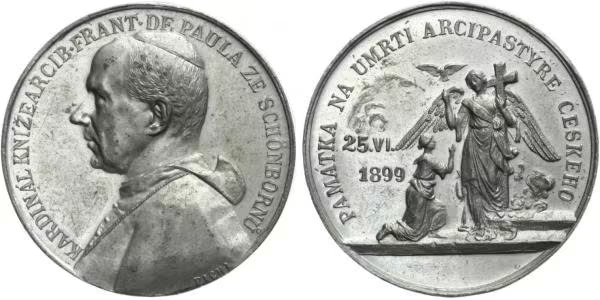
Praha - Arcibiskup Schönborn
Praha - arcib., František de Paula hrabě Schönborn, 1885 - 1899 AE Medaile 1899 (Pichl) - Úmrtní. Poprsí zleva, opis / Anděl s křížem, před ním, klečící žena ukazuje na letící holubici Cín 35 mm, Přibil.511, patina, zbytky lesku, rysky
Skladem 1 ks - Code: NASAS95-D1827
Sasko, 1/6 Tolaru 1827 - Úmrtní
Sasko, Friedrich August III. (1763 - 1827) 1/6 Tolaru 1827 S, KM.1107, krásná zachovalost, lesk, patina, nep. rysky, raženo 48 000 ks_R!
- Code: NBSAS-BZ1904EV
Sasko, 2 Marka 1904 E - Úmrtní
Sasko, Georg, 1902 - 1904 2 Mark 1904 E, Muldenhütten, KM.1261, J.132, velmi pěkná zachovalost, tmavá patina, drobné rysky